Blüthner piano guide
A practical guide to Blüthner grand pianos, including the maker’s distinctive patent action, later roller actions and the restoration questions that affect touch, repetition and value.
Overview
Warm tone, elegant scale designs and two action traditions
Professionally restored Blüthner grands can combine a warm, singing tone with an attractive cabinet and a smooth touch. Older instruments fitted with the maker’s patent action are often especially light and fluid; later pianos generally use the roller-action system familiar from most modern grands.
The name alone does not establish value. The scale design, length, action type, structural condition and standard of previous work all need to be considered together.
Typical questions
- Which model and length?
- Patent or roller action?
- Original or replaced action?
- What structural work is documented?
- When was it last regulated and voiced?
Action comparison
Blüthner patent action versus roller action
There is a crossover period, so date alone is not enough. Inspect the actual mechanism and judge its present condition.
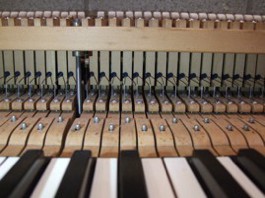
Approximately 1885–1925
Blüthner patent action
The patent action is unique to Blüthner and simpler than the roller action used by most other grand makers. Well-restored examples can feel exceptionally smooth and light.
Repetition is usually slower than a good roller action. Many players will not notice this in ordinary repertoire, but very rapid repeated notes can expose the difference.
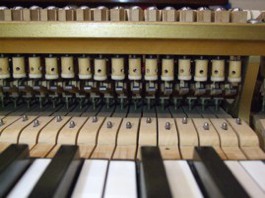
Common from the 1920s onward
Standard roller action
Roller actions became increasingly common from about 1920, with many examples dating from the mid-1920s onward. Their design is closer to the modern grand-action standard.
A well-regulated roller action generally offers faster repetition, but age, wear, replacement parts and restoration quality remain decisive.
What the action difference means to a player
| Characteristic | Patent action | Roller action |
|---|---|---|
| Touch | Often light, smooth and distinctive | More familiar modern grand feel |
| Fast repetition | More limited in demanding repeated-note passages | Generally faster when well regulated |
| Restoration decision | Preserve its character where practical | Assess wear, geometry and replacement parts |
Frequently encountered model
The Blüthner Style 4 baby grand
The Style 4, approximately 4ft 11in, is one of the most commonly encountered smaller Blüthner grands. Good examples can have a smooth touch and a fine, silky tonal character. Cabinets are often restrained, with a plain music desk and square tapered legs; mahogany is frequently seen.
Demand for properly restored examples remains strong, but an unrestored piano should be valued only after the likely structural and action work has been established.
Preserve the instrument’s character
Some older patent-action pianos have been converted to modern actions. That may suit a particular player, but it changes the instrument’s mechanism and character. Before replacing an original action, compare the musical objective, restoration cost, geometry, reversibility and historical significance with an experienced restorer.
Find or assess a Blüthner grand
Browse our current stock or send the model, serial number, dimensions and photographs for an initial view. Arrange a technical inspection before buying privately.